

HKUST(GZ) Autonomous Crane System Makes Science Robotics Cover
Could a crane as tall as a six-story building lift a container weighing dozens of metric tons with the precision of a bottle cap? That is the question Professor Jun YANG of HKUST(GZ) and Professor Shihua LI of Southeast University set out to answer eight years ago, working with their teams and Shanghai Master Matrix Information Technology. Their answer is Autane, an autonomous operating system for rubber-tired gantry (RTG) cranes. The work was published on Nov 12 in Science Robotics under the title "Autane: An autonomous crane for sustained port operations", and chosen as the cover paper.
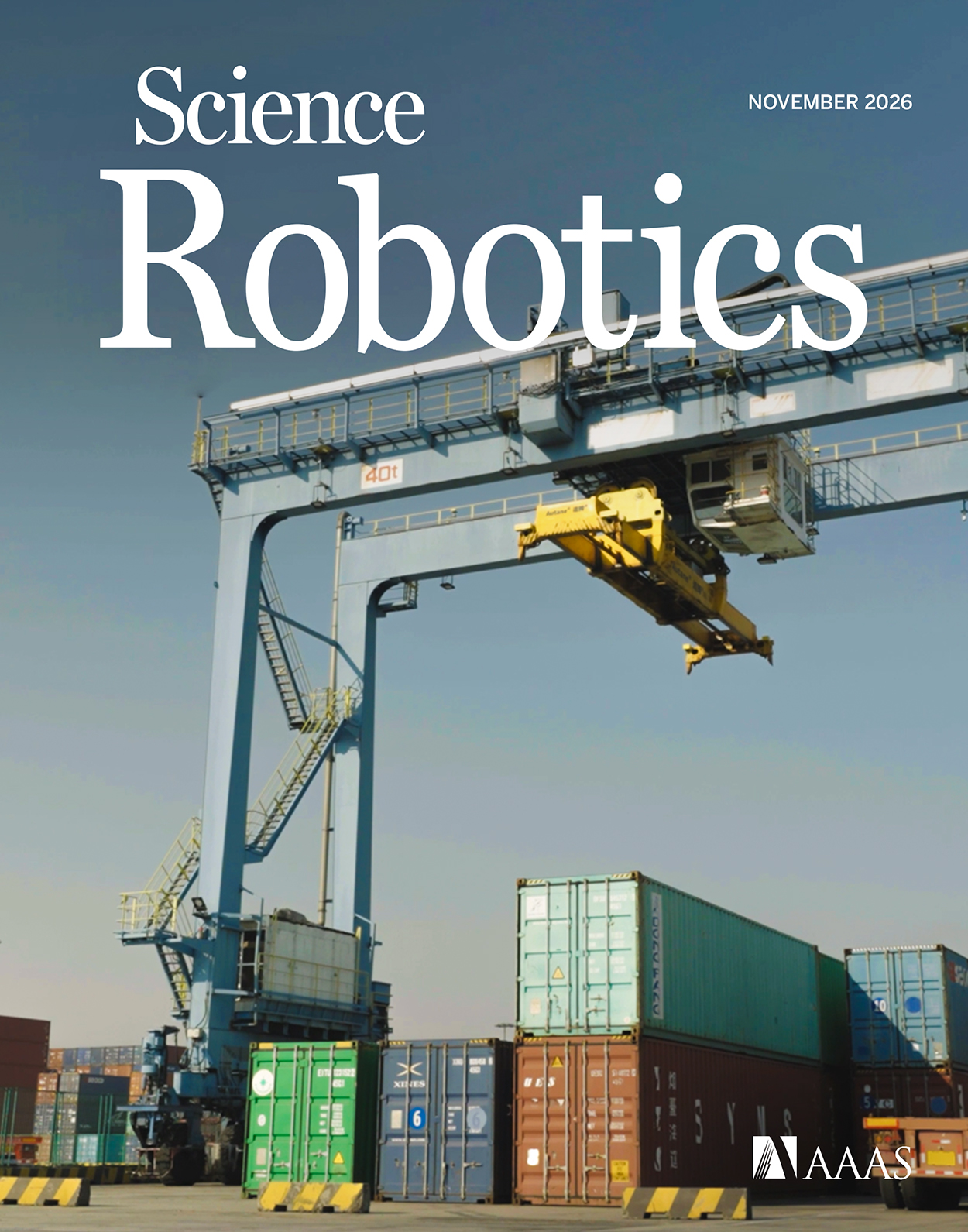
Professor Jun YANG from the Robotics and Autonomous Systems Thrust of The Hong Kong University of Science and Technology (Guangzhou) has published the latest research findings in the international academic journal Science Robotics.
First author / co-corresponding author: Jun YANG, The Hong Kong University of Science and Technology (Guangzhou)
Co-corresponding author: Shihua LI, Southeast University
Full paper: www.science.org/doi/10.1126/scirobotics.ady5784
Autane now runs on more than 60 machines at ports in Shanghai, Ningbo, Suzhou, and Hong Kong, across five crane models of different generations, and has handled over 4.8 million TEUs without a single safety incident. What makes the task so hard is not just the size but the flexibility. A container is 12 meters long, yet the locking holes are only 8 cm wide, leaving a placement tolerance of 3 cm, and all of this happens while the container hangs from a wire rope that sways in the wind and rain.


To address this, the system equips traditional cranes with dozens of sensors, including LiDARs, cameras, GNSS, and IMU, and ties them into a closed loop covering perception, planning, control, and maintenance. Multi-sensor fusion and SLAM let the crane see the yard, container slots and pedestrians in real time, while model predictive control and disturbance rejection keep the suspended container from swinging. Around 90 percent of transient faults clear without human intervention, and sensors recalibrate themselves automatically.
In more than 60,000 operations, the system has averaged a task success rate of 91.23 percent and an efficiency of 25.93 container moves per hour, on par with skilled drivers. It keeps working in winds of 15 m/s, daily rainfall of 25 mm, and visibility of 50 meters, holding steady at night and in rain when human performance tends to slip. The team frames the goal as freeing workers from dangerous, extreme, and harsh environments rather than replacing them.


